The Grand Ethiopian Rennaissance Dam.
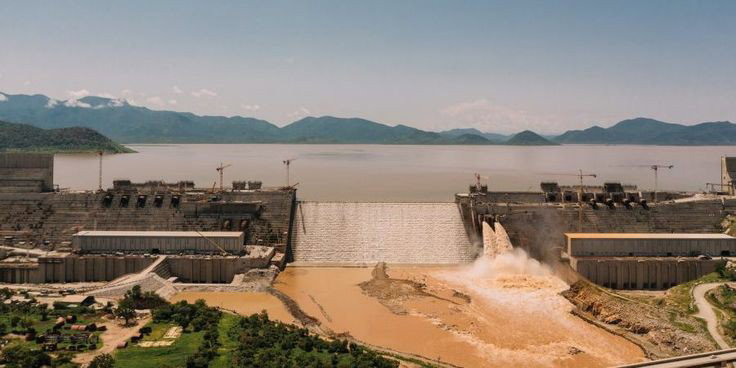
By: Powell Buluma
The Greek historian Herodotus once quoted, "Egypt is wholly the gift of the Nile". The river had sustained Egyptian civilization for millennia, and Egyptian reliance on the river only grew with the rapid increase in population within the country. By the end of 2023, the population of the country will be around 113 million and is projected to surpass 160 million by 2050. Egypt's unique location, cutting right through the Sahara Desert, means that most of these people settled along the Nile's banks, with over 95% of them living just a few kilometres from the river. Due to the country's near-non-existent rainfall, most of Egypt's water supply is reliant on the Nile, with some projections placing it as the source of over 90% of the entire country's supply. Toby Wilkinson, an experienced Egyptologist, quoted, “Egypt is the Nile, the Nile Egypt," and looking at how intertwined the country's existence is on the Nile, this statement is not farfetched.
Then there is Ethiopia, a nation with a history almost as old as Egypt and a population larger than even that of Egypt. The country hosts Lake Tana, from which the Blue Nile originates. The significance of the Blue Nile cannot be understated. Despite the White Nile having a longer river course, up to 56% of the water that eventually forms the Nile originates from the Blue Nile, and this volume swells to over 80% during the East African monsoon lasting between June and September. The Blue Nile's trajectory through the Ethiopian Highlands generates tremendous kinetic energy, perfect for hydroelectric power generation. When past Ethiopian administrations proposed building a dam on the river, they were unsurprisingly met with huge resistance from Egypt, as the dams were viewed as an existential threat to Egypt's existence that sometimes threatened to boil over into military hostilities between the two countries. This was clearly seen in 1978 when the then Egyptian president, Anwar Sadat, made an ominous statement in response to an Ethiopian plan to build a dam by stating, '' We are not going to wait to die of thirst in Egypt. We'll go to Ethiopia and die there instead."
This standoff continued for decades until 2011 when Egypt was engulfed in a revolution that deposed the then President Hosni Mubarak. The political instability in Egypt allowed Ethiopia to begin construction of the Grand Ethiopian Rennaissance Dam. Upon completion it would be the largest dam in Africa and seventh largest in the world. The sheer scale of the dam would revolutionise Ethiopia's economic and social prospects. The dam's capacity to produce up to 6,500 megawatts of electricity, would have been twice the amount of electricity produced annually in Ethiopia which would in turn, have the effect of providing dependable power to over 60% of the population that had not been linked to the grid.
The construction of the Dam was completed in July of 2020 and by then Egypt's political instability had subsided. Egypt began to formally complain against the filing of the dam as they wanted a filling period of around 20 years so that the flow of water to Egypt would only be slightly interrupted. Ethiopia was reluctant on this proposal as it would have meant a loss in Billions of dollars' worth of projected revenue and economic benefits from the dam. In addition to this, Egypt demanded that during drought, the dam would start releasing enough water downstream. Ethiopia once again rejected this proposal because of the vague nature of what exactly constituted drought commitments. Ethiopia's lack of cooperation further extended to the appointment of dispute settling bodies such as the African Union on the matter following proposals by Egypt and Sudan.
In July of 2021, Ethiopia began its second filling of the dam during the monsoon season leading to Egypt and Sudan referring the matter to the United Nations Security Council for the first time. Ethiopia then carried out a third filling in July of 2022 which had been the largest of the three fillings. A 2021 Environmental impact report showed that Egypt stood to lose up to 28 billion dollars in Agricultural output if the Ethiopians filled the GERD in 5 years. Even if the dam was filled over the course of 10 years, Egypt would still stand to lose up to 17 billion dollars in lost agricultural output.
The vastly opposing goals of each state makes it hard for any of them to compromise on the matter. Egypt's existence is reliant on the Nile and if this was to be threatened, Egypt as a state could cease to exist. Leaving such a vulnerable issue of national security in the hands of a foreign nation is an issue that will plague Egyptian administrators for a long time to come. Ethiopia on the other hand views the dam as essential for her economic future. The economic benefits could potentially propel Ethiopia into an industrial powerhouse of the 21st century and any threats to this will be met with equal resistance from the Ethiopian administration.
The lack of diplomatic compliance from Ethiopia and Egypt has led to statements suggesting military intervention from Egypt is on the table. Egyptian president Abdel Fattah El Sisi said " I am telling you and I am telling my brothers in Ethiopia, let's not reach a point where you touch a drop of water from Egypt, because all options are open". One might wonder why Egypt feels entitled to control what happens to the Nile in other countries? The answer to this lies in the 1929 Anglo-Egyptian treaty between Britain and Egypt. In this treaty, the newly independent Egypt granted Britain control over the Suez Canal and in return, Britain, which then controlled vast portion of Africa, surrendered sovereignty and water rights over all the Nile to Egypt. Ethiopia was not consulted on the matter and has since then continually denied acknowledging this treaty as applicable to the Blue Nile that runs through their territory.
Ethiopia's plan is to fill the dam by 2027 and it is yet to be seen what exactly Egypt will do. They can sit back and hope the effects won't be as devastating to their country or they can gamble and undertake a military operation. The latter would most certainly bring international condemnation and threaten to become a regional conflict. Kenya and Ethiopia have had a defence pact since 1963 initially formed to curb Somalia's militaristic ambitions in the region seeking to unite all Somalis into an ethno-state. This treaty would obligate either state to come to the military aid of the other if attacked by an outside power. The result of such a conflict would be incalculable and lead to tremendous loss of both life and property.
Like most things in life, no conflict is wholly black and white. Both sides usually have legitimate concerns that might not be easy to compromise on. It is my hope that no such conflicts will occur but that is an answer to which only the future holds.
