THE UNDHR: 75 Years later
By: Kelvin Kamau
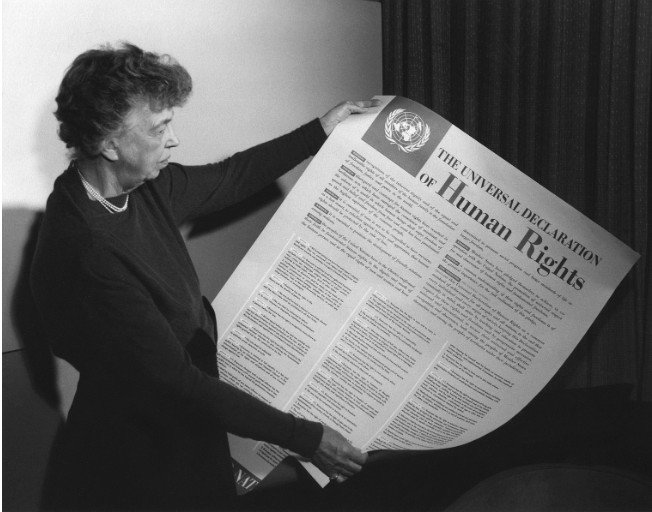
Vladimir Ilyich Lenin most probably had the Russian Bolshevik revolution when he stated that, "There are decades where nothing happens; and there are weeks where decades happen." That statement however could also describe the happenings of December 10th, 1948 and the weeks leading up to it, for it was on this day that the United Nations Declaration on Human Rights was adopted a few minutes to midnight by the United Nations General Assembly, then barely three years old. The Universal Declaration of Human Rights was adopted by the United Nations General Assembly resolution 217A at its 3rd session in Paris. To date 75 years have passed and the charter has been a source for political movements and the agitation of rights as well as the baseline and for various international law conventions and norms since 1948. Subsequent conventions such as the European convention of Human Rights and the African Charter on Human and Peoples Rights amongst others heavily draw from this groundbreaking declaration. It was also arguably the first global expression and declaration of what a majority believe are the rights to which all human beings are inherently entitled.
The declaration is especially well placed in the context of the twentieth century as it especially came after the Second World War with its widespread brutality and depravity but just before the spread of decolonization in the global south; however most remarkable is also how it was able to incorporate the views of the global south as well as the voice of women. The declarations drafting was the responsibility of the UN Commission on Human Rights which was chaired by Eleanor Roosevelt and had other members such as the Chinese philosopher Peng Chung Chan, the Lebanese philosopher Charles Malik, the French and Chilean jurist and judge Herman Cruz and Rene Cassin amongst others. In terms of state perhaps the most notable contribution was by that of Latin American countries which had the largest regional delegation at 19 out of 50 participating nations. Their contribution is enhanced by the fact that through the Bogota declaration they had pioneered the path for an international approach as regards human rights.
The declaration in its preamble does aptly lay out its aim as to recognize, “the inherent dignity and of the equal and inalienable rights of all members of the human family. The preamble then proceeds to give a backdrop of human history to that point coupled to a laying out of attendant duties as well as responsibilities in all in order to achieve the declaration. The preamble in doing this also bares open the aim of the drafters in making the declaration a watershed moment in human history, a curtain on the barbarous past and a door to a world of justice, freedom and peace. The preamble is then followed by a distilling of the rights in thirty articles which are not legally binding but have formed a basis for other legally binding conventions and agreements. In his later reflections on the charter, Andrade Carrera was perhaps the one who laid out best the vision and mission of the declaration by stating. “… the declaration must be a tool in the hands of the man in the street and not a mere ornament of international law ...”
One of the most powerful aspects of the UNDHR is perhaps contained in the title of the declaration itself. It is the word universal, this word in a nutshell does show the sheer scale of ambition as well as vision that the drafters as well as the original signatories and subsequent nations adopt. The sheer scale of the word is perhaps best articulated by Thomas Paine who views then in a timeless manner and proceeds to state of human rights, “the rights of all generations of men [which] cannot be monopolized by any." Furthermore the fact that they were intended to accrue to all with no regard to their sex, race, caste, religion, tribe, talent or other feature underscores their universality.
It is the former United Nations Secretary general who gave the best assessment of the declaration vis-à-vis its aims as earlier stated when he stated inter alia, “……. It (the declaration) has become a yardstick by which we measure right and wrong. It provides a foundation for a just and decent future for all, and has given people everywhere a powerful tool in the fight against oppression, impunity and affronts to human dignity……. Human rights abuses did not end when the Universal Declaration was adopted. But since then, countless people have gained greater freedom. Violations have been prevented; independence and autonomy have been attained. Many people – though not all – have been able to secure freedom from torture, unjustified imprisonment, summary execution, enforced disappearance, persecution and unjust discrimination, as well as fair access to education, economic opportunities, and adequate resources and health-care. They have obtained justice for wrongs, and national and international protection for their rights, through the strong architecture of the international human rights legal system…….”
The story of the United Nations Declaration on Human Rights is still unfolding and at present, 75 years on is still unfinished. It is imperative for us present and living generations to be as visionary and daring in its implementation, protection and advancement as the drafters and adapters were in its making and creation. As we celebrate the 75 years of is existence the need to continuously imagine what new journeys anchored on human rights we could embark on persists. The bell is yet to toll!
